

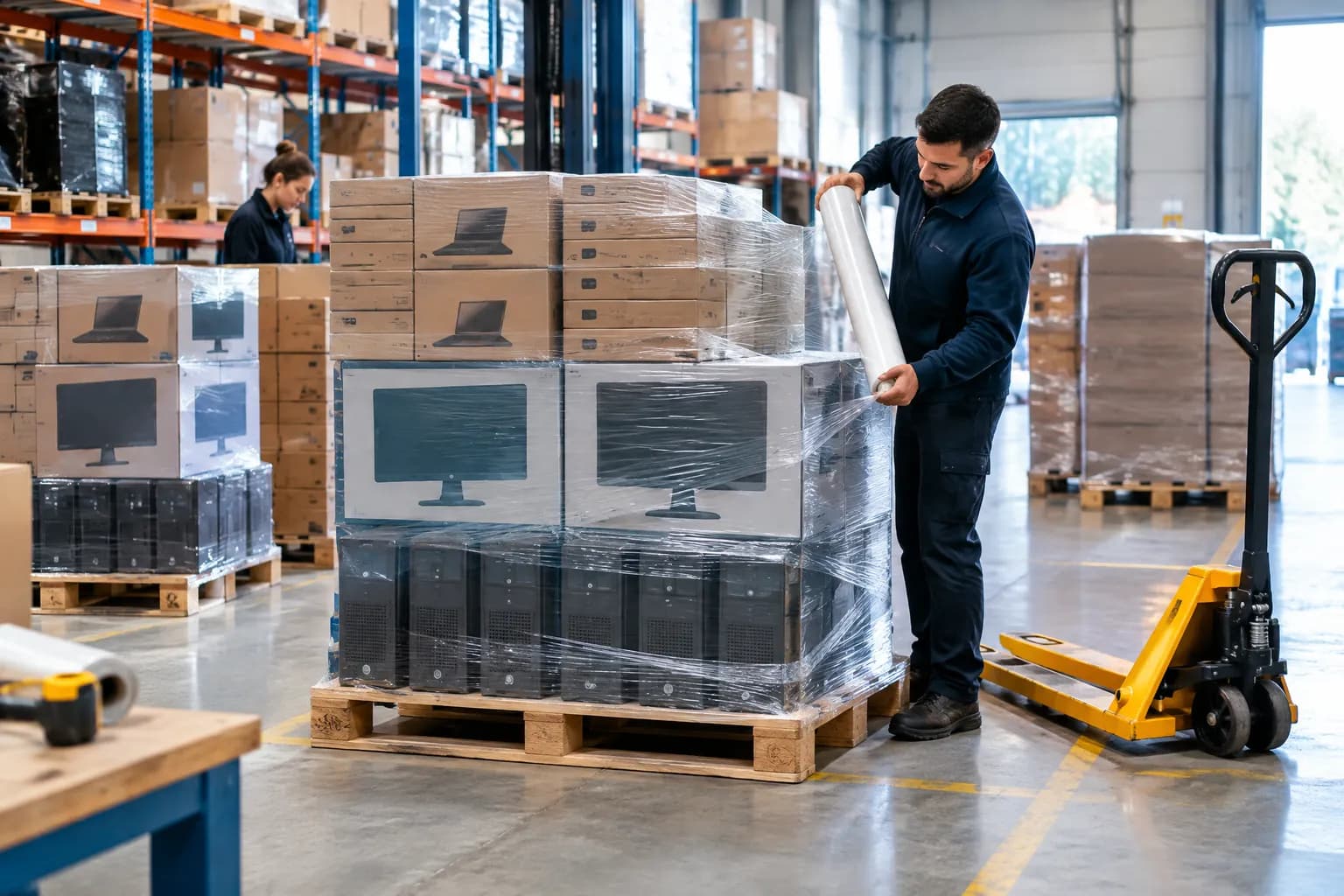
Consolidating a mixed IT order in Dubai means collecting goods from several suppliers at one forwarder's warehouse, checking and repacking them against one packing list, and shipping them together under one set of documents. It usually lowers freight and clearing costs, but the whole shipment waits for the slowest item, so it pays to plan which lines travel together.
Why consolidate at all?
A typical project order mixes categories: laptops from one supplier, monitors from another, switches and access points from a third, UPS units from a fourth. Shipped separately, each consignment carries its own origin charges, freight minimums, documents and clearing fees. Shipped together, those costs are paid once, the clearing agent handles one declaration, and the site receives one delivery to check and sign for.
Consolidation also improves control. Goods from different suppliers meet in one place, where they can be counted, inspected and labelled to one standard before they leave, instead of arriving at your door in four different states of packing.
How does consolidation work in practice?
- Each supplier delivers to an agreed forwarder's warehouse in Dubai by a set date.
- The warehouse receives, counts and records each delivery against the order.
- Goods are checked, labelled and palletised, with dangerous goods kept apart.
- One packing list is drawn up by pallet and carton, with weights and dimensions.
- One commercial invoice lists every line with its HS code, quantity and value.
- The forwarder books air or sea freight and files the export declaration.
Which items complicate a mixed shipment?
Batteries, above all. Laptops, tablets and wireless peripherals carry lithium-ion cells, and UPS units carry sealed lead-acid or lithium batteries. Air carriers apply IATA dangerous-goods rules, and a consignment that includes declared batteries needs the right packing, labels and paperwork; some carriers restrict certain battery types on some routes. Heavy UPS battery packs are usually cheaper and simpler by sea. Radio equipment can complicate things as well, when a destination's type-approval process applies to some lines and not to others.
Should you consolidate or split?
| Situation | Consolidate | Split |
|---|---|---|
| All lines confirmed with similar lead times | Yes | Not needed |
| One line has a much longer lead time | Only if the project can wait | Ship the ready lines first |
| Urgent laptops plus heavy UPS units | Not by air | Laptops by air, UPS by sea |
| Several small lines from different suppliers | Yes, to share freight minimums | Not needed |
| Lines needing destination certificates at different times | Possible, with planning | Often simpler to split by certificate |
Which documents does a consolidated shipment need?
The document set is the same as for any IT export, with extra care over detail. The commercial invoice should give each line its own description, HS code, quantity and value, because duty rates differ between laptops, switches and UPS units. The packing list should show what sits on each pallet, and the serial-number list should cover every serialised item. A certificate of origin is issued for the consignment, and any conformity certificates must match the lines they cover.
How long can goods wait in a consolidation warehouse?
That depends on the warehouse's terms, not on the Incoterm. Forwarders usually allow a free storage period and then charge by pallet or cubic metre, and goods held beyond it start to cost money and raise insurance questions. Build the cut-off date around the line with the longest lead time, and decide early whether a late line will wait, ship separately or be cancelled.
How should the packing list be structured?
Number every pallet and every carton, and list contents carton by carton: model, quantity, serial list reference, gross and net weight. Mark batteries, fragile panels and orientation on the outside. A packing list that lets the receiving team find any serial in minutes saves days when goods are split between sites or checked by customs.
Can goods of different origins travel together?
Yes. A consolidated shipment often contains goods made in several countries, and the commercial invoice can state origin line by line. If your destination grants preferential duty by origin, ask your clearing agent what evidence it needs before the goods ship, because origin paperwork is hard to add after departure.
Planning tips that prevent delays
- Fix a cut-off date for supplier deliveries to the warehouse and agree in advance what happens to late lines.
- Ask for photos of each pallet before it is wrapped.
- Label cartons by site or department if the goods will be distributed on arrival.
- Keep different keyboard layouts and plug types in separate, clearly marked cartons.
- Confirm the warehouse can store goods securely if a line runs late.
- Insure the consolidated value, not just the largest line.
How does FC Trading handle mixed orders?
Mixed orders are much of what a sourcing intermediary is for. We quote each line from suppliers in Dubai, agree a delivery cut-off with them, and consolidate at an independent forwarder's warehouse, or deliver to your own forwarder if you prefer. Where splitting the shipment saves time or cost, we say so and quote both options side by side. Either way, you receive one packing list and one serial list that cover every line, so your receiving team checks the delivery against a single set of papers.
Related reading
- Export logistics and documentation- Consolidation, freight and paperwork
- IT procurement services- One quote across categories
- Power and UPS- Batteries that change the freight plan
- Incoterms for IT shipments from Dubai- Choosing the term for a mixed load
- Shipping laptops with lithium batteries- Battery detail on Wholesale Laptops Dubai
Related reading


Leave a Comment
Your email address will not be published.