


Choose new IT equipment when a tender, warranty requirement or long support life demands it, and refurbished when the workload is well understood, the models will stay supported for the life of the project and the supplier can document the grade, test results and data sanitisation. Most projects end up with a mix, and the decision works best line by line rather than for a whole order.
What does refurbished actually mean?
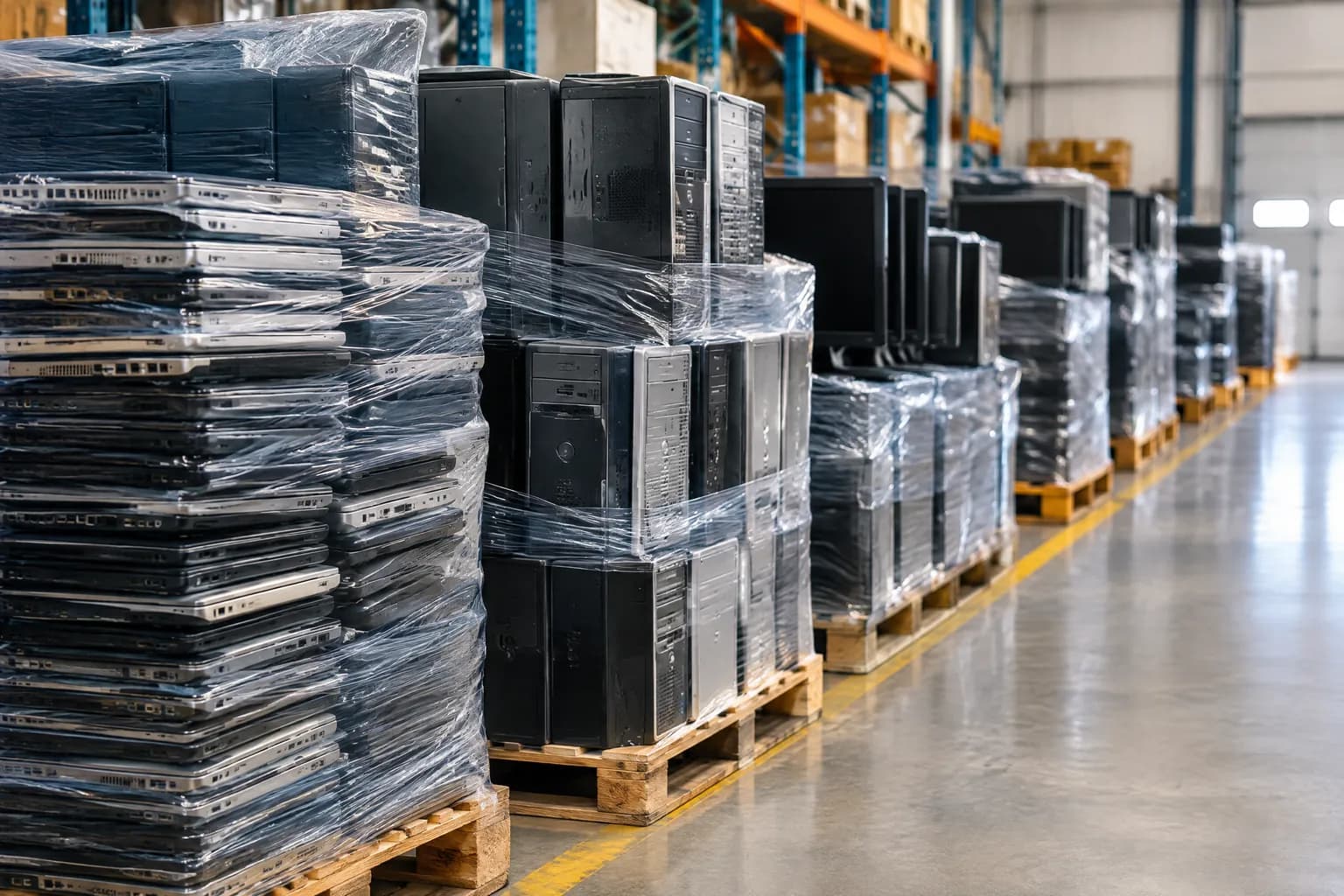
Refurbished business IT is usually previous-generation equipment that has come back from corporate leases, fleet refreshes or data-centre decommissioning, been tested and cleaned, and been graded by cosmetic condition. It is not the same as used or as-is equipment, which is sold as described without full testing. The grade describes appearance, not performance: a Grade B laptop should work exactly like a Grade A one; it just looks more used.
| Term | What it should mean |
|---|---|
| New (sealed) | Never used; factory-sealed in retail or bulk packaging |
| Open box | New, but the packaging has been opened; accessories or the original box may be missing |
| Refurbished Grade A | Works fully and has been tested; light wear at most; battery health given per lot |
| Refurbished Grade B | Works fully and has been tested; visible scratches, marks or wear |
| Refurbished Grade C | Works, but heavily worn; suited to price-led or parts use |
| Used or as-is | Sold as the supplier describes it, untested or partly tested, against a manifest |
Suppliers do not all grade the same way, so ask for each supplier's written definitions and compare them before you compare prices.
When is new the better choice?
- The tender or donor rules require new equipment.
- Manufacturer warranty and on-site support are essential to the service you run.
- The equipment must stay in service, with security updates, for many years.
- You need current features such as Wi-Fi 7, the latest processors or specific security hardware.
- The equipment is client-facing and appearance matters.
When does refurbished make more sense?
- Training rooms, school labs and call centres with predictable workloads.
- Secondary offices, field sites and spares pools.
- Servers and switches for non-critical or lab use, or where a previous-generation platform still receives firmware updates.
- Projects where budget would otherwise cut the number of seats or sites.
- Matching an existing fleet of a model that is no longer sold new.
Why check the support life before the price?
The biggest hidden risk with refurbished IT is not hardware failure but software support. Microsoft's standard support for Windows 10 ended in October 2025, paid extended updates aside, and Windows 11 runs only on processors on Microsoft's supported list, broadly Intel 8th generation or AMD Ryzen 2000 series and newer, with TPM 2.0. Network vendors publish end-of-sale and end-of-support dates for each switch and firewall family, after which security fixes stop. Before you accept a refurbished model, look up its support dates and make sure they outlast your project.
How do new and refurbished compare over a project?
| Factor | New | Refurbished |
|---|---|---|
| Upfront cost | Higher | Lower; varies with grade and age |
| Warranty | Manufacturer warranty, subject to region | Supplier warranty where offered |
| Support life | Longest remaining | Shorter; check vendor dates |
| Lead time | Depends on distributor allocation | Depends on the lots suppliers offer |
| Consistency across units | Identical units | Grade, battery and layout can vary within a lot |
| Environmental footprint | Full manufacturing impact | Extends the life of existing hardware |
What evidence should a refurbished quote come with?
- The supplier's grading definitions.
- Functional test results, per unit or per lot.
- Battery-health figures for laptops and tablets.
- Data-sanitisation reports for any device with storage.
- Confirmation that BIOS passwords, activation locks and device-management enrolment have been removed.
- Licence status for operating systems, network features and security subscriptions.
We ask suppliers for this evidence and pass it on with the quote. Where a supplier cannot provide it, we say so before you decide.
Which categories refurbish well, and which less so?
Business laptops and desktops from corporate lines refurbish well: they are built for long duty cycles, parts are plentiful and grading is well understood. Rack servers and enterprise switches also have a deep refurbished market, because data centres retire them on schedule rather than when they fail. Consumer-grade devices, batteries and anything with heavy mechanical wear refurbish less predictably. Storage is a special case: refurbished arrays are common, but many buyers prefer new drives inside them.
Within a category, newer is safer. A refurbished laptop two or three generations old usually has years of support left; one six generations old may already sit outside the operating system's supported list.
How should condition be written into an RFQ or tender?
Name the grade and ask for its definition rather than writing 'good condition'. State the minimum battery health you will accept for laptops, whether mixed keyboard layouts are acceptable, whether units must come with or without an operating system, and the warranty you expect. If refurbished equivalents are allowed in a tender, say how they will be evaluated against new, so suppliers can price both honestly.
A practical rule for mixed projects
Split the project by role. Staff who will carry a laptop for years get new; labs, spares and temporary sites get refurbished; core network and storage go new unless a refurbished platform has clear support dates. Price both options for the borderline lines and let the total project cost decide.
For donor-funded and public projects, check the procurement rules early. Some programmes accept refurbished equipment only with documented testing and warranty, others exclude it entirely, and a few favour it for environmental reasons. Knowing which applies saves a round of requotes.
Related reading
- Refurbished IT equipment- Grades, evidence and use cases
- Bulk and clearance lots- How we broker supplier lots
- Pre-shipment inspection for IT equipment- Checking grade and locks before dispatch
- IT for education programmes- Labs, tablets and tenders
- Refurbished laptops, model by model- On Wholesale Laptops Dubai
Related reading

Leave a Comment
Your email address will not be published.